
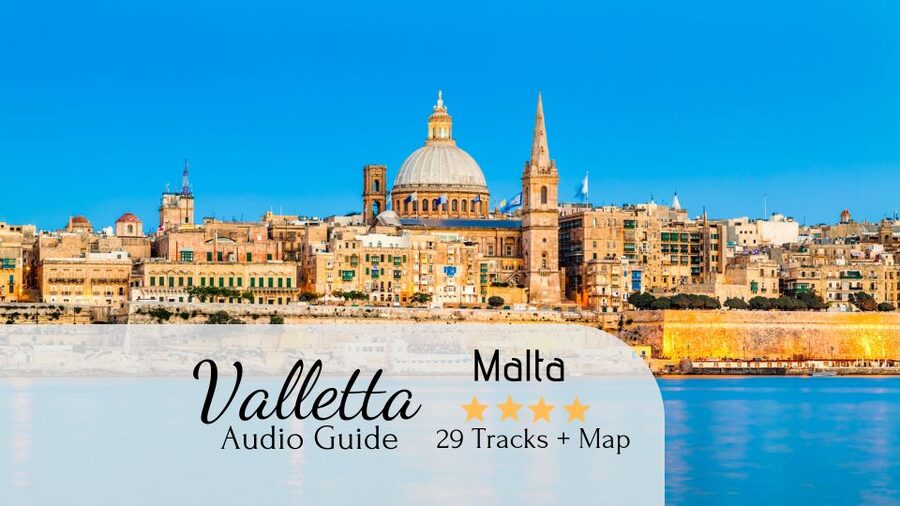
Reviewed · VALLETTA WALKING TOURS
Valletta: Self-Guided Audio Tour, Map and Directions
Valletta is made for walking, and this self-guided audio tour helps you do it on your schedule. I like that you get 29 professionally produced MP3 tracks in English, plus a printable map with directions, so you can move from stop to stop without guessing. One caution: the audio can feel a bit clumsy to download, and the files may not be in a clean playback order.
This is also a smart option if you want history that you can control. The narration is built for you to learn while you wander, covering major highlights like St. John’s Co-Cathedral, Fort Saint Elmo, and the Grand Master’s Palace at a comfortable pace. The main drawback is simple: it’s not a live guide, so you’ll rely on the map and the audio to keep everything making sense.
If you’re the type who likes to pause, backtrack, and spend extra time when something grabs you, you’ll probably enjoy this format. If you hate tech chores, though, you’ll want to test the download before you head out.
In This Review
- Key things I’d notice first
- What this self-guided Valletta walk really gives you
- Following the route: how to make the map and 29 tracks work
- Valletta Main Gate to the city center: getting your bearings fast
- Freedom Square and Republic Street
- Royal Opera House and Saint Francis Church
- Museum of Archaeology
- St. John’s Co-Cathedral, Great Siege Square, and the National Library
- St. John’s Co-Cathedral
- Great Siege Square and National Library
- Grand Master’s Palace and Auberge de Castille: where the official side lives
- Grand Master’s Palace
- Auberge de Castille
- Fort Saint Elmo, Sacra Infermeria, and the Siege Bell Monument
- Fort Saint Elmo and National War Museum
- Sacra Infermeria and Siege Bell Monument
- Barracca Gardens, Saint Barbara Bastions, and Victoria Gate for a calmer rhythm
- Lower Barracca Gardens and Upper Barracca Gardens
- Saint Barbara Bastions and Victoria Gate
- Merchants Street to Palazzo Parisio: style, streets, and a change of pace
- Why Merchants Street matters here
- Palazzo Parisio as a palate cleanser
- Auberge de Castille, Our Lady of Victories, Saint James’ Cavalier, and museum time
- Our Lady of Victories
- Saint James’ Cavalier and Museum of Fine Arts
- Hastings Garden to finish
- The MP3 reality: download order and what you should do about it
- Value check: $9 for 29 tracks and a route you can repeat
- Who this tour suits best (and who might prefer something else)
- Should you book Valletta: Self-Guided Audio Tour, Map and Directions?
- FAQ
- Where do I start the Valletta self-guided audio tour?
- How long does the tour take?
- Is this a guided tour with a person?
- What language is the audio guide in?
- What format are the audio tracks in, and do I need an MP3 player?
- What’s included in the price?
Key things I’d notice first
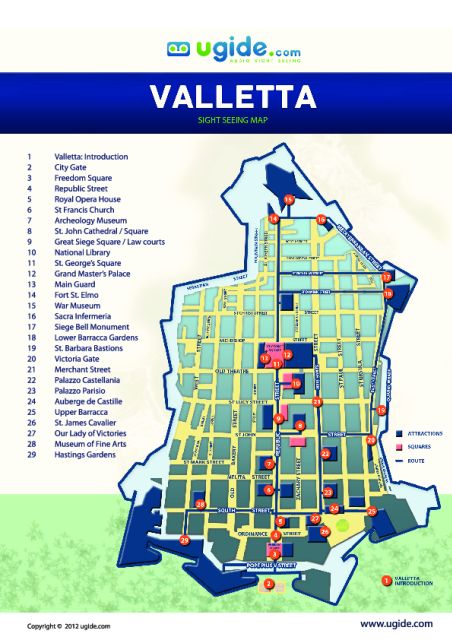
- Starts at Valletta Main Gate, so you have a clear place to begin and orient
- 29 MP3 tracks that combine landmark info with turn-by-turn style guidance
- Printable map and directions to cut down on screen time
- Real landmark clusters you can follow in sequence: squares, palaces, bastions, and gardens
- Good for cruise-day planning, because it helps you get oriented before you branch out
- Possible download friction, including issues with sporadic order when playing files
More Valletta walking tours we have followed through the old streets
- Valletta: 3-Hour Walking Tour
★ 4.7 · 1,605 reviews - Valletta: Guided City Walking Tour
★ 4.8 · 1,256 reviews - Valletta: Street Food and Culture Walking Tour
★ 4.8 · 1,251 reviews - Valletta: City Walking Tour in a Small Group
★ 4.9 · 957 reviews
What this self-guided Valletta walk really gives you
This tour is built around one idea: you control the pace. You start at the Valletta Main Gate, then follow a mapped route while listening to tracks on your phone or MP3 device. It’s designed for exactly the kind of sightseeing Valletta rewards: short distances, frequent turns, and lots of “wait, stop here” moments.
The value here is not a guide standing in front of you. It’s the combination of audio + directions + a map. That means you can skip a stop, linger at one square, or take a different rhythm through the city without feeling guilty. In a place like Valletta, that matters. The streets are compact and the highlights come quickly, so a flexible plan beats a rigid one.
The route is packaged as a set of 29 tracks (MP3 files). Each track corresponds to a named stop, starting with the Valletta Introduction and running through the city highlights and final garden areas. The audio is in English, and it’s meant to be listened to at your leisure once downloaded.
Following the route: how to make the map and 29 tracks work
The tour is straightforward on paper: you download the audio after booking, use the included printable map and directions, and start at Valletta Main Gate. In practice, your success comes down to how you manage two things: your listening sequence and how often you check the map.
Here’s how I’d set it up so it feels smooth:
1) Download everything first, before you walk.
You’re paying for an audio walk, not just the idea of one. If downloads are slow or temperamental, that eats your time outdoors.
2) Plan your “listening mode.”
Some MP3 packs can be annoying when the file order doesn’t match the walk order. One review noted clumsy downloads and that the files played in sporadic order. If that happens to you, don’t panic. You can either:
- Use the file list each time you switch tracks (slower, but reliable), or
- Create your own listening order on your device if your player supports it.
3) Use the map as your anchor.
You don’t need to stare at it every step, but you do want the route in your hands. The map is there so the audio doesn’t have to be perfect for navigation to work.
4) Keep the full 2 hours as a guideline, not a rule.
The stated duration is 2 hours. That’s enough time to move through most stops without sprinting, especially if you’re mostly walking and only pausing briefly at each point.
If you’re the type who likes to take photos, stop for water, or linger at views, you’ll likely fill the two hours by default. The tour works best when you treat it as a paced loop, not a strict appointment.
Valletta Main Gate to the city center: getting your bearings fast
The route begins with the Valletta Introduction and then moves through the early structure of the city, including stops like City Gate, Freedom Square, and Republic Street. This is the part you’ll feel most: the city’s “shape” comes into focus here.
If you’re arriving from somewhere else in Malta or you’re doing Valletta as part of a day plan, this opening segment is your orientation toolkit. Audio that starts at the gate and walks you through the core streets helps you learn where things are without needing a guide to explain the whole city at once.
More guided Malta tours with a Maltese local up front


Freedom Square and Republic Street
These track stops are useful because they connect you to the flow of the city. You get context while you’re still fresh, so later landmarks land better. Think of it as setting the mental GPS.
Royal Opera House and Saint Francis Church
Then the route adds cultural and religious landmarks such as the Royal Opera House and Saint Francis Church. This is where the tour becomes more than walking directions. The audio is doing the storytelling job while you’re passing through streets where the architecture does the talking.
Museum of Archaeology
The Museum of Archaeology track is a good reminder that Valletta isn’t only about outdoor landmarks. If you’re curious, this is the sort of stop that can turn a walk into a half-day plan, because you might want to spend extra time even though the tour is built for a 2-hour window.
St. John’s Co-Cathedral, Great Siege Square, and the National Library
This is one of the tour’s biggest stretches: major landmarks paired with big historical framing. You’ll see tracks including St. John’s Co-Cathedral, Great Siege Square, and the National Library.
St. John’s Co-Cathedral
The audio here is specifically positioned to help you understand what you’re looking at. Since one of the stated themes is the story of the Knights of St. John, this track is a key piece. Even if you don’t stop to go inside, the narration helps connect the landmark to the larger fortified-city context Valletta is known for.
Great Siege Square and National Library
These stops work well because they’re not just single points of interest. They create a sense of place in time, tying the city’s identity to what happened there and why it matters.
One practical benefit: if you’re doing Valletta with limited time, major landmarks can be overwhelming. The audio structure helps you take them one at a time instead of trying to absorb everything visually in a single pass.
Grand Master’s Palace and Auberge de Castille: where the official side lives
Two big “anchor” stops in the list are Grand Master’s Palace and Auberge de Castille. The tour also includes related tracks like Main Guard that bridge you between sites.
Grand Master’s Palace
This is where the tour’s scale becomes more obvious. You’re being guided to one of Valletta’s centerpiece institutions, and the narration helps frame why it’s important. For me, this type of track is valuable because it reduces guesswork. Without an audio cue, a palace can look impressive but still feel hard to place.
Auberge de Castille
The Auberge de Castille track continues the story theme: the Knights’ presence wasn’t just ceremonial. Listening here can make the architecture and civic order feel connected rather than random.
If you’re the kind of traveler who likes to understand the “why” behind buildings, these tracks are your best payoff.
Fort Saint Elmo, Sacra Infermeria, and the Siege Bell Monument
Then you shift into the defense-and-crisis part of Valletta’s identity, with tracks including Fort Saint Elmo, Sacra Infermeria, and Siege Bell Monument. The tour also lists National War Museum, which pairs naturally with this stretch.
Fort Saint Elmo and National War Museum
This section is ideal if you want the city’s military story explained while you’re still walking the spaces where it played out. The audio doesn’t just point you to a site; it guides you through the logic of the city’s fortifications.
Sacra Infermeria and Siege Bell Monument
These two tracks are good examples of how the route uses variety: not only big fort or square landmarks, but also specialized sites and symbols. If you like learning about the less-obvious parts of a destination, the inclusion of places like Sacra Infermeria and the Siege Bell Monument can make the tour feel more satisfying than a “top 10 sights” list.
Barracca Gardens, Saint Barbara Bastions, and Victoria Gate for a calmer rhythm
A walking tour can get tiring, especially with two dozen-plus stops. That’s why the route includes breaks in the form of Lower Barracca Gardens, Upper Barracca Gardens, and Hastings Garden, along with Saint Barbara Bastions and Victoria Gate.
Lower Barracca Gardens and Upper Barracca Gardens
These are natural resets in the walk. Even if you only spend a few minutes listening and taking in the space, the gardens give you a breather between heavier historic stops.
Saint Barbara Bastions and Victoria Gate
The bastions and gates keep the fortified feel present while you move toward the next stretch. You’re not losing context; you’re getting small changes in scenery and pacing.
If you’re doing this on a day when your feet are already tired, this “softer scenery” section is your recovery zone.
Merchants Street to Palazzo Parisio: style, streets, and a change of pace
The list includes Merchants Street, Castellania, Palazzo Parisio, and then continues on toward later civic and cultural buildings.
This stretch can be a great time to “let the city talk.” With so many stops, it’s easy to turn Valletta into a checklist. The inclusion of a palazzo—Palazzo Parisio—helps you shift into a more visual, architecture-forward mode while still staying within the tour’s narrative structure.
Why Merchants Street matters here
Streets like Merchants Street are often where you feel daily life in a historic city. Even when you’re focused on landmarks, the audio can help you notice the street itself as a destination, not just a corridor between highlights.
Palazzo Parisio as a palate cleanser
A palazzo track can feel like a reward after forts and siege-era context. If you’re doing Valletta in one go, this stop is a good “change gear” moment.
Auberge de Castille, Our Lady of Victories, Saint James’ Cavalier, and museum time
The route includes Our Lady of Victories, Saint James’ Cavalier, Museum of Fine Arts, and Hastings Garden at the end of the list.
Our Lady of Victories
This track offers continuity with the religious and civic themes that show up earlier. It also works as a way to stay oriented as the tour moves toward its final cluster.
Saint James’ Cavalier and Museum of Fine Arts
These are a culture-focused close. If you like art or indoor breaks, these tracks are the kind that can help you decide whether to spend extra time or just keep moving.
Hastings Garden to finish
Ending in a garden is a classic strategy for walking tours. You get a natural landing spot where you can sit for a minute, replay the last track, and decide if you’re ready to head back or keep exploring on your own.
The MP3 reality: download order and what you should do about it
The tour provides MP3 audio files and an included map and directions, but it does not include an MP3 player. That matters for two reasons.
First, you’ll need to bring the device you’ll listen on. The tour is designed for either an MP3 player or a mobile device.
Second, the audio setup is where your experience can rise or fall. One review called out that downloads were clumsy and that audio files were in sporadic order, meaning the narration may not play seamlessly in the exact track sequence.
Here’s what you can do to protect yourself from that:
- Before you go: confirm that you can open the files and that you can switch between tracks quickly.
- While you walk: expect that you may need to jump to a specific downloaded file if the order isn’t perfect.
- Plan a tiny buffer: if your start point is time-sensitive, leave a little slack so you’re not troubleshooting at street level.
When it works smoothly, this kind of audio tour is a joy because you get narration on demand. When it doesn’t, the map becomes your best friend.
Value check: $9 for 29 tracks and a route you can repeat
At $9 per person for a roughly 2-hour walk, this is mostly about whether you’ll actually use the audio. The pricing makes sense if you value structure without committing to a group schedule.
You’re buying:
- 29 audio tracks in MP3 format
- a Valletta map and directions
- a route that you can repeat later, on another day, or during another pass through the city
It’s not the best deal if you want a live Q&A, because there isn’t one. It’s also not ideal if you know you’ll avoid tech steps like downloading files.
But if you’re someone who likes self-paced travel, this price is low enough that you can justify it as an “orientation tool” even if you don’t follow every stop exactly.
One review mentioned using the audio tour to get familiar with the city before planning other Malta sites. That’s the kind of use case where this shines: you learn the layout, then you decide what deserves more time.
Who this tour suits best (and who might prefer something else)
This tour fits best if you:
- want a self-guided Valletta experience that stays flexible
- like learning while you walk, not after you return
- can follow a printable map and directions
- don’t need a live guide to explain everything from scratch
You might want a different format if:
- you hate dealing with downloads and file management
- you need constant help navigating and don’t want to check a map
- you’re looking for a guided conversation, not a curated listening route
Should you book Valletta: Self-Guided Audio Tour, Map and Directions?
I’d book it if you want an easy way to see major Valletta highlights in about two hours, using 29 MP3 tracks and a route you can reference anytime. The combo of landmarks like St. John’s Co-Cathedral, Fort Saint Elmo, and key civic sites (including the Grand Master’s Palace and Auberge de Castille) gives you a lot of learning without a schedule fight.
I’d think twice if you’re likely to be frustrated by download issues or prefer everything to be perfectly automatic. In that case, try to prepare your audio before you start walking, and treat the map as your navigation backbone.
FAQ
Where do I start the Valletta self-guided audio tour?
You start at the Valletta Main Gate.
How long does the tour take?
The duration is listed as 2 hours.
Is this a guided tour with a person?
No. It is not a guided tour. You download and listen to the audio, and you follow the printable map and directions.
What language is the audio guide in?
The audio guide is provided in English.
What format are the audio tracks in, and do I need an MP3 player?
The tracks are in MP3 format. An MP3 player is not included, so you’ll need your own device.
What’s included in the price?
You get 29 audio tracks in MP3 format and a Valletta map and directions.
More Tours in Valletta






More Tour Reviews in Valletta
More Valletta Walking Tours


Wondering what else is on? More Malta and Gozo trips from our own notebook




Valletta Walking Tours, compared.
 ★ 5.0The Original Valletta Walking TourFrom $262,719 reviews
 ★ 4.7Valletta: 3-Hour Walking TourFrom $251,605 reviews
 ★ 4.8Valletta: Guided City Walking TourFrom $241,256 reviews
 ★ 4.8Valletta: Street Food and Culture Walking TourFrom $651,251 reviews
 ★ 4.9Valletta: City Walking Tour in a Small GroupFrom $24957 reviews
 ★ 4.3From Sliema: Valletta and the Three Cities Scenic CruiseFrom $24763 reviews
 ★ 4.3Valletta: Guided Walking Tour with Optional Cathedral TourFrom $46758 reviews
 ★ 5.0Valletta Food TourFrom $60711 reviews
Browse the lists this tour appears in